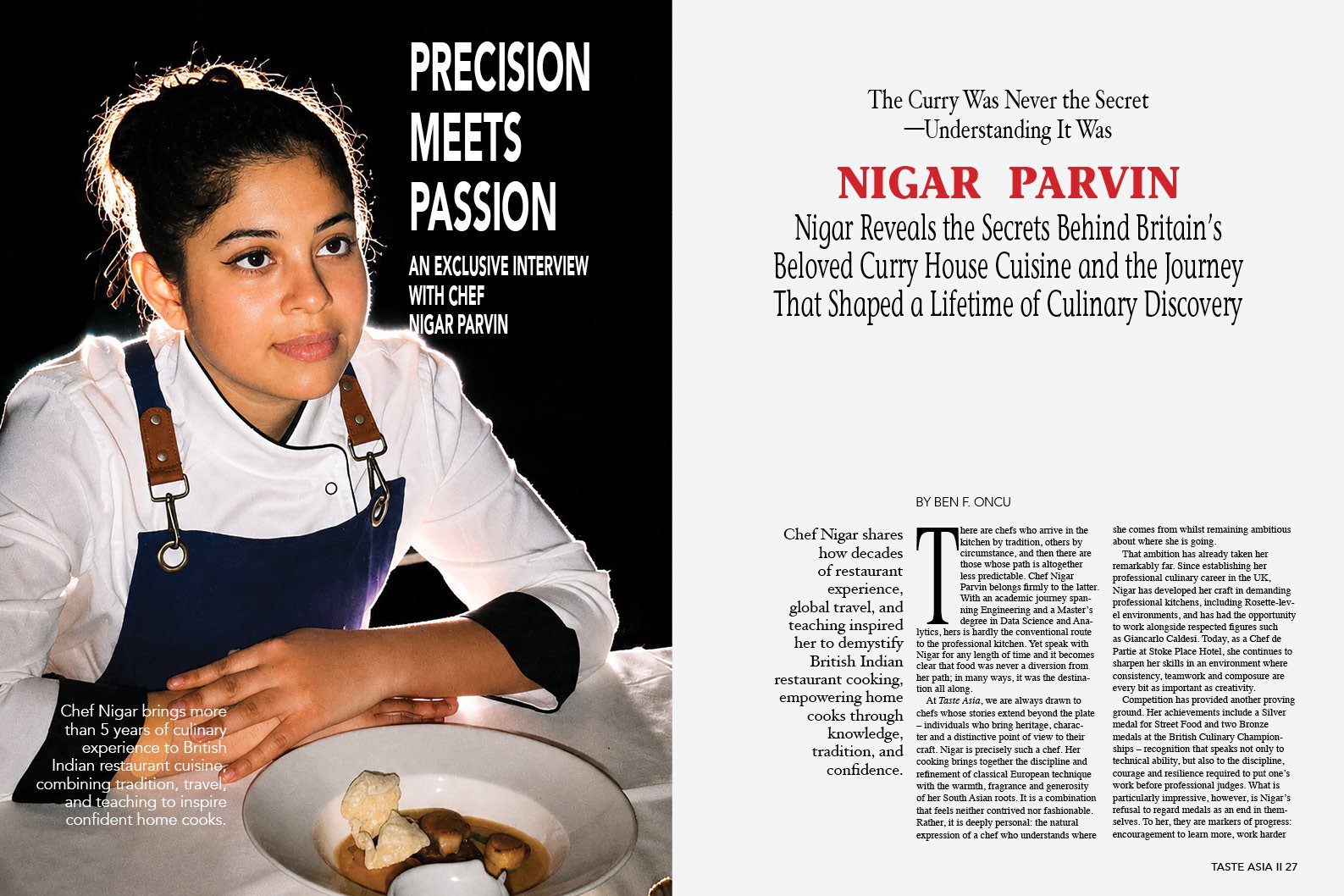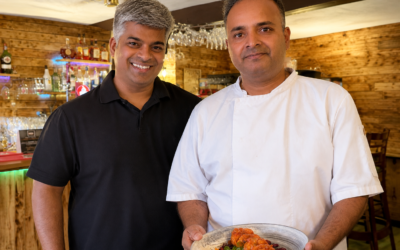







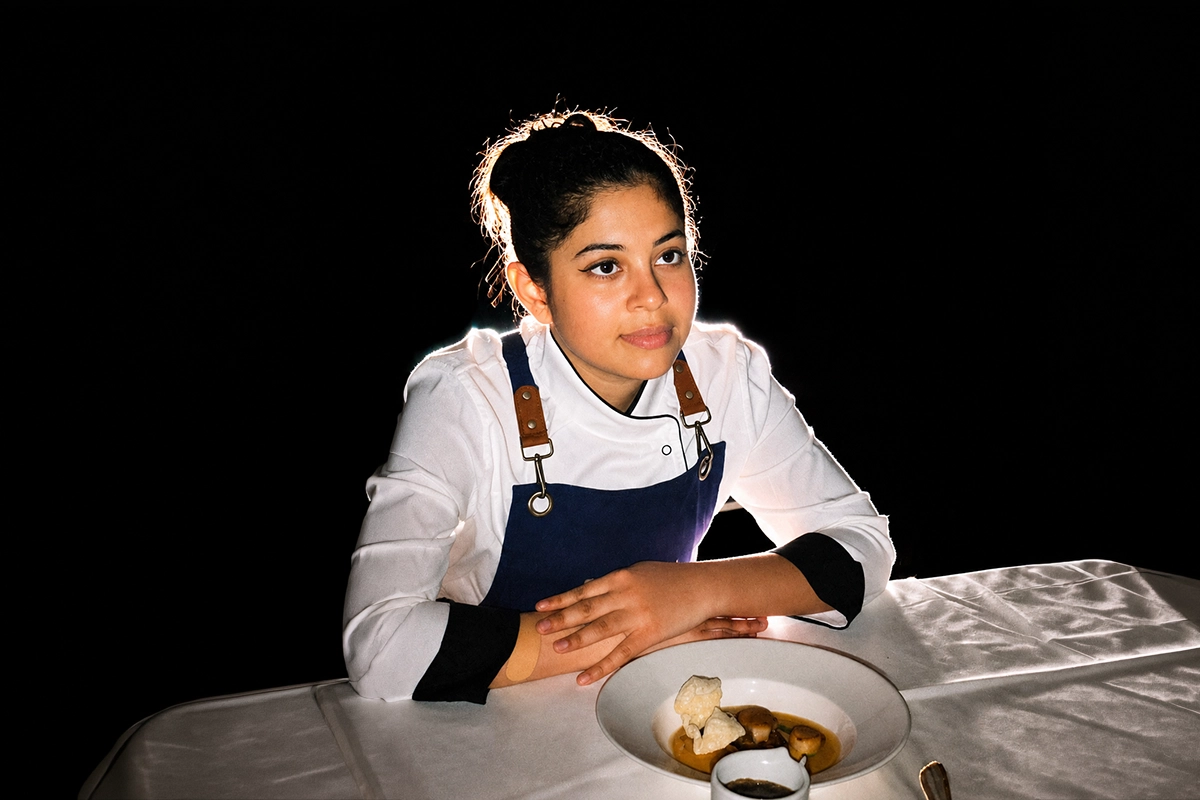
Photo: Chef Nigar Parvin brings more than 5 years of culinary experience to British Indian restaurant cuisine, combining tradition, travel, and teaching to inspire confident home cooks.
The Curry Was Never the Secret—Understanding It Was
Chef Nigar shares how decades of restaurant experience, global travel, and teaching inspired him to demystify British Indian restaurant cooking, empowering home cooks through knowledge, tradition, and confidence.
There are chefs who arrive in the kitchen by tradition, others by circumstance, and then there are those whose path is altogether less predictable. Chef Nigar Parvin belongs firmly to the latter. With an academic journey spanning Engineering and a Master’s degree in Data Science and Analytics, hers is hardly the conventional route to the professional kitchen. Yet speak with Nigar for any length of time and it becomes clear that food was never a diversion from her path; in many ways, it was the destination all along.
At Taste Asia, we are always drawn to chefs whose stories extend beyond the plate – individuals who bring heritage, character and a distinctive point of view to their craft. Nigar is precisely such a chef. Her cooking brings together the discipline and refinement of classical European technique with the warmth, fragrance and generosity of her South Asian roots. It is a combination that feels neither contrived nor fashionable. Rather, it is deeply personal: the natural expression of a chef who understands where she comes from whilst remaining ambitious about where she is going.
That ambition has already taken her remarkably far. Since establishing her professional culinary career in the UK, Nigar has developed her craft in demanding professional kitchens, including Rosette-level environments, and has had the opportunity to work alongside respected figures such as Giancarlo Caldesi. Today, as a Chef de Partie at Stoke Place Hotel, she continues to sharpen her skills in an environment where consistency, teamwork and composure are every bit as important as creativity.
Competition has provided another proving ground. Her achievements include a Silver medal for Street Food and two Bronze medals at the British Culinary Championships – recognition that speaks not only to technical ability, but also to the discipline, courage and resilience required to put one’s work before professional judges. What is particularly impressive, however, is Nigar’s refusal to regard medals as an end in themselves. To her, they are markers of progress: encouragement to learn more, work harder and continue pushing the boundaries of her own ability.
Her food reflects that same thoughtful approach. Dishes such as Chicken Meatballs in Rich White Gravy reveal a cook interested in the conversation between cultures, whilst her Scallops with Cauliflower Purée demonstrate an appreciation for elegance, restraint and classical technique. Nigar does not pursue fusion for novelty’s sake. Her philosophy is more considered: respect the ingredient, understand the technique and introduce flavours only when they genuinely earn their place on the plate.
Perhaps this instinct comes from her earliest and most important culinary influence – her mother. Long before professional brigades, competitions and restaurant kitchens entered the picture, Nigar learnt that cooking could communicate something deeply human. Food could carry memory, culture and affection; it could gather people around a table and make an ordinary moment significant. That philosophy remains at the heart of her work today.
What makes her story even more compelling is that her ambitions extend well beyond restaurant service. Alongside the intensity of professional kitchen life, Nigar has developed a growing collection of more than 80 original recipes, with the aim of making accomplished cooking approachable to the home cook. It is an admirable philosophy: restaurant technique need not be intimidating, and beautiful food need not be inaccessible. Knowledge, when shared generously, can give people the confidence to cook better.
There is also something particularly refreshing about a chef who can speak with equal enthusiasm about the emotional memory of a Bengali fish curry and the analytical logic of improving kitchen workflow. Her background in Data Science has not disappeared beneath the chef’s whites; it has become another tool in her repertoire. Precision, pattern recognition, efficiency and method sit alongside instinct, taste, memory and imagination. In Nigar’s kitchen, science and creativity are not opposing forces – they are partners.
And she is still looking forward. A restaurant of her own, a cookbook bringing European technique together with the vibrant flavours of South Asia, and opportunities to teach and mentor the next generation all feature in her ambitions. For a chef still relatively early in her professional journey, there is a striking clarity of purpose.
The culinary industry is richer when it makes room for voices and journeys such as hers: women prepared to challenge convention, chefs unafraid to cross cultural and professional boundaries, and cooks who understand that ambition and humility can – and should – occupy the same kitchen.
Nigar Parvin is building her career one service, one dish and one challenge at a time. There is technical discipline in what she does, certainly, but there is also warmth, curiosity and an unmistakable desire to keep improving. Her own philosophy perhaps expresses it best: “Cooking is an act of love.”
After our conversation with Nigar, it is difficult to think of a more fitting description of both her food and the journey behind it.
In this edition of Taste Asia, we discuss the leap from Data Science to professional kitchens, lessons learnt alongside Giancarlo Caldesi, the pressure and exhilaration of culinary competition, navigating a male-dominated industry, the flavours of her Bengali and South Asian heritage, and the ambitions driving the next chapter of a promising culinary career.
Highlights From the Interview
- Nigar Parvin made an unconventional transition from Data Science and Analytics into professional kitchens.
- Her cooking combines classical European techniques with Bengali and wider South Asian flavours.
- She currently works as Chef de Partie at Stoke Place Hotel.
- Her professional experience includes working alongside respected Italian chef Giancarlo Caldesi.
- She won Silver for Street Food and two Bronze medals at the British Culinary Championships.
- Her signature Chicken Meatballs in Rich White Gravy captures her philosophy of cultural harmony on a plate.
- She has developed more than 80 original recipes aimed at making accomplished cooking accessible to home cooks.
- Her data science background influences kitchen organisation, efficiency, recipe development and waste reduction.
- Her mother remains one of the most important influences on her relationship with food.
- Future ambitions include opening her own restaurant, publishing a cookbook and mentoring younger chefs.
- She believes fusion should have purpose rather than simply combining cuisines for novelty.
- Her guiding philosophy is simple: “Cooking is an act of love.”
Your website opens with the line “Cooking is an act of love.” How do you hold onto that sentiment during a slammed Saturday service at Stoke Place Hotel, when the tickets are endless and the pressure is at its peak?
People often imagine love as something gentle and calm, but in a professional kitchen it also means commitment, discipline and respect. During a busy Saturday service, there isn’t much time to stop and reflect, but every plate still represents someone’s celebration, family dinner or special memory. That thought keeps me grounded.
Pressure is part of our profession, yet I believe consistency comes from preparation and teamwork rather than panic. When every chef communicates, trusts one another and focuses on the details, the kitchen moves almost like an orchestra. Even during the busiest service, I remind myself that every dish leaving the pass carries my name and my standards. Cooking with love doesn’t disappear under pressure—it becomes the reason I push myself to maintain quality no matter how busy the service becomes.
You hold an MSc in Data Science & Analytics from Royal Holloway — a world away from the pass. What prompted the leap into professional kitchens, and does that analytical background ever give you an unexpected edge behind the stove?
Many people are surprised by my background, but to me the transition was completely natural. Data Science taught me how to analyse problems, recognise patterns and make informed decisions. Cooking satisfies a different part of my personality—the creative side—but the two disciplines complement each other more than people might expect.
In the kitchen, organisation, timing and precision are everything. My analytical training helps me manage workflow efficiently, minimise waste, optimise preparation and remain calm under pressure. Recipe development also benefits from this mindset because I naturally evaluate ingredients, techniques and flavour combinations methodically before refining them through experience and instinct.
Ultimately, my Master’s degree gave me valuable analytical skills, but becoming a chef fulfilled my passion. Food allows me to create something that brings immediate happiness to people, and that is incredibly rewarding.
You spent time at the AA Rosette Caldesi in Campagna working alongside Giancarlo Caldesi. What was the single most important lesson — technical or philosophical — that he imprinted on your cooking?
Working with Giancarlo Caldesi was a defining chapter in my career. Beyond the technical knowledge, the greatest lesson I learned was that simplicity demands mastery.
It is easy to hide behind complicated techniques or excessive garnishes, but creating a beautifully balanced dish with only a handful of ingredients requires confidence, restraint and respect for the produce. Watching how every ingredient was treated—from preparation to presentation—reinforced the importance of allowing quality ingredients to speak for themselves.
That philosophy continues to influence my cooking today. Whether I prepare a refined European dish or reinterpret flavours from my South Asian heritage, I always ask myself one question: “Does every ingredient truly deserve to be on the plate?” If the answer is no, it doesn’t belong there.
You took home Silver for Street Food and two Bronzes at the British Culinary Championships. Walk us through competition day: the adrenaline, the dishes you presented, and what those medals represent to you personally?
Competition day is unlike any normal service. There is an incredible mix of excitement, nerves and determination. Every second matters, every movement is deliberate, and every decision has the potential to influence the final result. While the pressure is intense, it is also incredibly motivating because you are competing alongside some exceptionally talented chefs.
For me, those competitions were never simply about winning medals. They were an opportunity to challenge myself outside my comfort zone and measure my skills against national standards. The Silver and Bronze medals represent perseverance, countless hours of practice and the willingness to keep learning from every experience.
Perhaps the greatest reward was the confidence those competitions gave me. They reminded me that growth comes from embracing challenges, accepting constructive criticism and continuously striving to b
ecome a better chef. Those medals are milestones in my journey, but they are not the destination. They inspire me to keep learning, competing and pushing my own boundaries.
Your cooking seems to marry classical European technique with the flavours of your heritage. How do you navigate that fusion without diluting either side — and which dish on your menu best captures that balance?
For me, fusion should never be about mixing cuisines simply for the sake of being different. Every ingredient and every technique must have a purpose. I have enormous respect for classical European cooking because it teaches discipline, precision and an understanding of flavour. Equally, my South Asian heritage has given me an instinctive appreciation for spices, aromas and bold yet balanced flavours.
Rather than forcing the two together, I let them complement each other naturally. I often use European cooking methods while allowing carefully selected South Asian spices to enhance the dish without overwhelming it. My aim is always harmony, not contrast.
One dish that perfectly reflects this philosophy is my **Chicken Meatballs in Rich White Gravy**. The preparation and presentation are rooted in classical European technique, while the delicate use of aromatic spices and layered flavours reflects the cooking I grew up with. It tells my story on a plate—where tradition meets modern refinement.
Your signature Chicken Meatballs in Rich White Gravy and Scallops with Cauliflower Purée are beautifully distinct. Where does a new dish begin for you — with a memory, an ingredient, or a technique you want to master?
Every new dish begins differently, which is one of the things I love most about cooking. Sometimes it starts with a childhood memory—a particular aroma or family recipe that stays with me. Other times it begins with discovering an exceptional seasonal ingredient or wanting to perfect a technique I’ve admired.
I spend a great deal of time thinking about balance. I ask myself how the flavours will interact, how the textures will complement one another and whether every element contributes something meaningful to the final dish.
I rarely create a dish in a single attempt. It often goes through several versions before I feel it truly represents my standards. I believe the best recipes are developed through patience, curiosity and the willingness to keep improving.
The professional kitchen is still a male-dominated space. Have you faced moments where you had to prove yourself twice over, and what advice would you offer young women considering a culinary career today?
Professional kitchens are becoming more diverse, but there are still moments when women feel they have to work harder to earn the same recognition. Early in my career, I realised that the best response wasn’t to argue—it was to let my work speak for itself.
Every challenge strengthened my confidence and reinforced my determination to keep learning. Today, I focus on consistency, professionalism and maintaining high standards regardless of who is watching.
My advice to young women is simple: believe in your abilities, never stop learning and don’t allow anyone to define your limits. There will always be obstacles, but resilience, discipline and passion are far more powerful than stereotypes. If you truly love cooking, don’t let fear prevent you from pursuing your dream. The industry needs more talented women bringing their creativity and leadership into professional kitchens.
You’re running a growing platform with 80+ original recipes while working full-time as a Chef de Partie. How do you carve out the energy for recipe development and content creation, and do the two roles ever bleed into each other?
Balancing a full-time kitchen role with recipe development certainly requires discipline and careful time management. Most of my recipe testing happens during my days off or late evenings, when I can slow down and experiment without the pressure of service.
Interestingly, the two roles constantly inspire one another. Working in professional kitchens exposes me to new ingredients, techniques and flavour combinations that often become the starting point for recipes on my platform. At the same time, developing recipes for home cooks reminds me that great food doesn’t need to be overly complicated.
My goal has always been to bridge the gap between restaurant-quality cooking and home kitchens. I want people to feel confident enough to try techniques they once believed were only possible in fine dining. If my recipes encourage someone to cook more often or discover a new passion for food, then all the extra hours are worthwhile.
A scallop dish with cauliflower purée and dill oil looks restaurant-grade, yet your ethos is about making cooking “approachable and enjoyable.” What’s your secret for translating professional technique into something a home cook on a Tuesday night can actually attempt?
I believe the biggest misconception about restaurant cooking is that it has to be complicated. In reality, great cooking is built on understanding a few core techniques and using quality ingredients well.
When I develop recipes for home cooks, I ask myself, “Can someone realistically make this after work with ingredients they can find locally?” If the answer is no, I simplify the process without compromising the flavour. For example, I break complex techniques into manageable steps, suggest practical alternatives where appropriate, and explain the “why” behind each method. Once people understand the purpose of a technique, they gain confidence to experiment.
Cooking should be enjoyable, not intimidating. If I can help someone prepare a dish that looks elegant, tastes delicious and brings their family together around the table, then I’ve achieved my goal.
You speak Hindi and Bengali, and your flavours clearly draw from South Asian roots. Are there dishes from your family table that you’ve never put on a restaurant menu but still cook for yourself?
Absolutely. Some of the most meaningful dishes I cook are the simplest ones—recipes that remind me of home and family. They may never appear on a fine dining menu, but they hold tremendous emotional value.
Traditional Bengali fish curries, slow-cooked lentils, fragrant rice dishes and comforting vegetable preparations are foods I return to whenever I want a sense of home. These recipes carry memories of family gatherings, celebrations and everyday meals shared with loved ones.
Although I don’t recreate them exactly in professional kitchens, the flavour profiles and techniques often influence my cooking. Those childhood experiences taught me that food is much more than nourishment—it is culture, memory and love served on a plate.
You’re currently Chef de Partie at Stoke Place Hotel under the Cairn Group. What’s the culture like there, and how is this chapter stretching you as a chef compared to your time in Bray or Windsor?
Every kitchen shapes a chef in a different way, and my time at Stoke Place Hotel has been another important step in my professional development.
The culture encourages teamwork, accountability and consistently high standards. Everyone understands that delivering an exceptional guest experience depends on every member of the brigade working together. That collaborative environment motivates me to keep improving every day.
Compared with my earlier experiences, this role has given me greater responsibility and challenged me to think beyond my own section. I’ve become more confident in managing service, mentoring junior chefs and maintaining consistency under pressure. Every new kitchen teaches something different, and I believe remaining open to learning is one of the most valuable qualities a chef can have.
You’ve worked in Rosette kitchens, won national medals, built a brand, and earned a Master’s degree — all before turning 30. What’s the ambition that still keeps you up at night: a cookbook, a restaurant, a teaching academy, or something else entirely?
To be honest, I hope my journey is only just beginning.
Owning my own restaurant is certainly one of my biggest dreams—not simply to serve exceptional food, but to create a place where guests feel welcomed, inspired and connected through memorable dining experiences.
I would also love to publish a Cookbook that reflects my journey, combining classical European techniques with the vibrant flavours of South Asia in a way that is both approachable and inspiring. Teaching is another passion of mine. Whether through workshops, online content or mentoring young chefs, I want to share the knowledge I’ve gained and encourage others to pursue their own culinary ambitions.
More than awards or titles, I hope to leave a lasting contribution to the culinary world. If people remember me as a chef who respected tradition, embraced innovation and inspired others to cook with confidence and love, I will consider that my greatest achievement.
Be honest: has your data science brain ever led you to build an Excel spreadsheet for your spice rack, mise en place, or prep lists? What’s the most “analytical” thing you’ve caught yourself doing in a kitchen?
Well,I haven’t gone as far as creating an Excel spreadsheet for my spice rack—although I wouldn’t rule it out! My data science background definitely influences the way I think in the kitchen.
I’m constantly analysing workflow, prep times and efficiency. I often find myself mentally calculating how changing one step can save several minutes during service or reduce unnecessary movement around the kitchen. I also enjoy documenting recipe trials, making small adjustments and comparing results until I achieve the balance I’m looking for.
In many ways, cooking is a science before it becomes an art. Precision, consistency and observation are just as important as creativity, and I enjoy bringing those two worlds together.
If you were sentenced to cook only one of your signature dishes for the rest of your life, but you got to choose the kitchen playlist, what are you cooking and what three songs are on repeat?
I would choose my **Chicken Meatballs in Rich White Gravy** because it represents both my heritage and my culinary journey. It’s comforting, elegant and endlessly satisfying. Every time I prepare it, I find small ways to refine and perfect it.
As for the playlist, music is a wonderful way to keep the energy positive during long hours in the kitchen. My three songs would be:
Lose yourself – Eminem
Viva La Vida – Coldplay
Perfect – Ed Sheeran
Those songs inspire me, help me stay focused and remind me why I love what I do.
What’s the most chaotic or bizarre thing you’ve ever witnessed in a professional kitchen that made you think, “I need to turn this into a recipe somehow”?
Every professional kitchen has moments that are unforgettable. One that always makes me smile was when a service became unexpectedly busy, and every chef instinctively switched into survival mode. Orders were flying in, pans were moving everywhere, people were communicating in short, rapid sentences, yet somehow every plate still left the kitchen beautifully presented.
After service, we all looked at each other and laughed because, despite the chaos, teamwork had carried us through. Moments like that remind me that kitchens are built on trust and resilience.
If I were to turn that experience into a recipe, I’d call it Controlled Chaos. The ingredients would be teamwork, communication, patience, resilience, a pinch of humour and plenty of passion.
One ingredient you think is wildly overrated, one you think is criminally underrated, and one you’d happily ban from every kitchen in the country if you had the power. Go.
Overrated: Gold leaf. It certainly creates visual impact, but it rarely contributes anything meaningful to flavour. Great food should impress through taste first, not just appearance.
Underrated: Fresh herbs. Ingredients like dill, coriander, parsley and tarragon can completely transform a dish when used thoughtfully. They add freshness, aroma and balance that people often underestimate.
Ban forever: Artificial truffle oil. Real truffles are extraordinary, but many synthetic truffle oils overpower a dish and mask its natural flavours. I believe ingredients should enhance one another rather than dominate the plate.