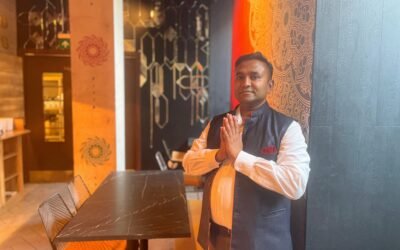



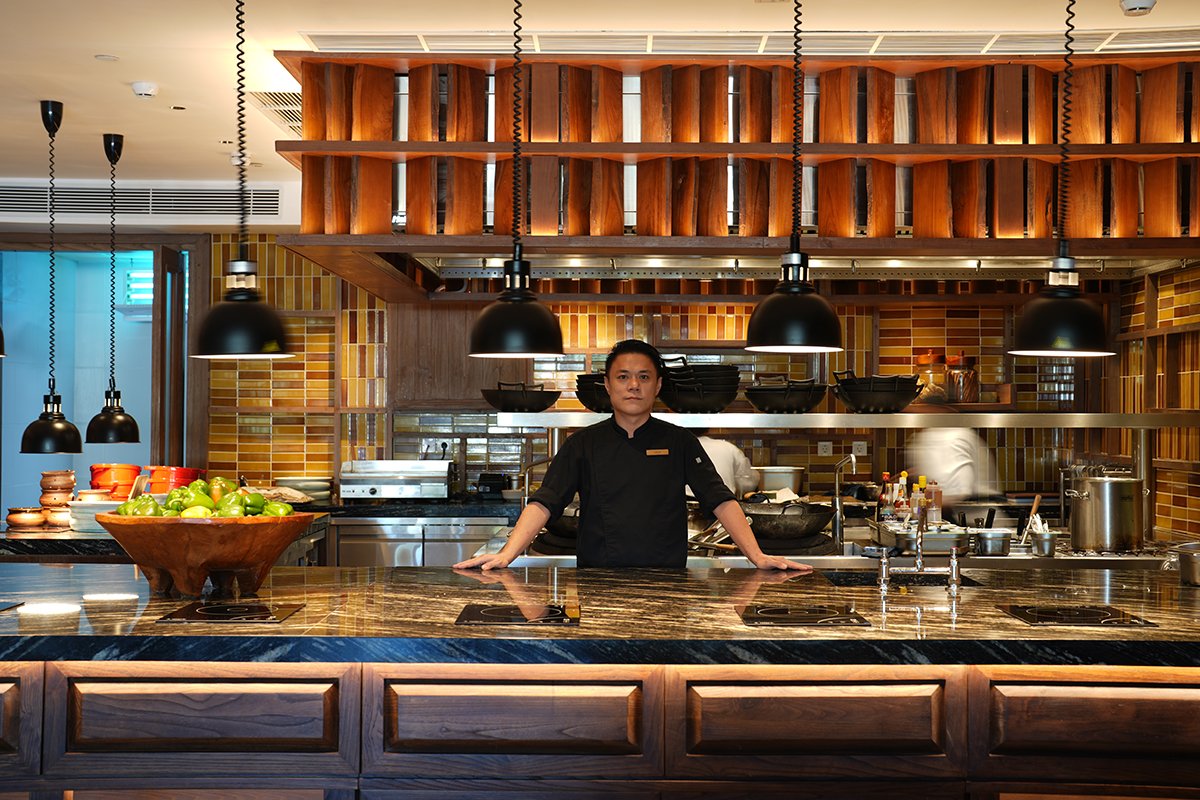
PHOTO: Chef Steve Chew Kim Seng brings more than two decades of international experience to his role as Chef de Cuisine at Grand Hyatt Bali.
Tradition, Reinvention And A Global Life In The Kitchen
Across more than two decades and seven countries, Chef Steve Chew Kim Seng has built a global career rooted in Chinese tradition, disciplined leadership, cultural adaptability and thoughtful culinary evolution.
F ew chefs understand the relationship between tradition, adaptation and international hospitality as deeply as Chef Steve Chew Kim Seng. With more than two decades in professional kitchens, his career has carried him from Malaysia and Singapore to Dubai, Ireland, Turkey, New Zealand and Indonesia, including roles with internationally recognised names such as Hakkasan and Mandarin Oriental.
Yet for all that travelling, Chinese cuisine has remained the constant at the centre of his culinary identity. What makes Steve’s perspective particularly compelling is his understanding that preserving tradition does not mean resisting change. Instead, he sees modern Chinese cooking as a careful balance: respecting the techniques and flavour logic that give a dish its identity while recognising how differently food can be understood across cultures.
Today, as Chef de Cuisine at Grand Hyatt Bali, Steve is applying that philosophy on a much larger scale. His work with the À La Minute Buffet concept reflects an ambition to bring the freshness, immediacy and discipline of restaurant cooking into a high-volume international hotel environment—without allowing quality or cultural identity to disappear in the process.
In this interview with Taste Asia, Steve speaks candidly about consistency, leadership, authenticity, multicultural kitchens and the lessons learned from cooking around the world. More importantly, he looks towards a new chapter in which all those experiences may finally come together in something distinctly his own.
Perhaps his most revealing ambition is also his simplest: one day, he hopes guests will taste his food and recognise it not as an imitation of somewhere else, but simply as Steve Chew’s Chinese food.
Highlights
- More Than 22 Years in Professional Kitchens
- A Culinary Career Spanning Seven Countries
- Malaysian Chinese Roots, Global Perspective
- Experience With Hakkasan and Mandarin Oriental
- Currently Chef de Cuisine at Grand Hyatt Bali
- Chinese Cuisine Remains the Foundation of His Cooking
- Advocates Innovation Without Losing Culinary Identity
- Developing the À La Minute Buffet Philosophy
- Believes Freshness Should Never Be Sacrificed for Volume
- Leads and Trains Multicultural Kitchen Teams
- Sees Consistency as the True Measure of Professionalism
- Believes Attitude Matters More Than Ego in Young Chefs
- Uses Commercial Limitations as a Source of Creativity
- Increasingly Interested in Ceramics and Tableware
- Dreams of Creating His Own Chinese Dining Concept
- Wants His Future Cuisine to Be Recognised Simply as “Steve Chew’s Chinese Food”
You have spent more than 22 years working in professional kitchens. What first inspired you to become a chef, and when did you realise that Chinese cuisine would become the centre of your career?
I started working very young. I was around 13 when I first came into contact with the kitchen, so before I really understood what a “career” meant, the kitchen was already part of my life.
There was no big dream at the beginning. I worked, I learned, I watched the senior chefs, and slowly I became attracted to the rhythm of a professional kitchen. I liked the pressure and the discipline, but more importantly, I liked being able to create something with my own hands and immediately see the reaction when someone ate it.
As I moved step by step into more professional kitchens, I began to understand how deep Chinese cuisine really is.
People often say “Chinese cuisine” as though it is one single cuisine, but within it there are completely different regional cultures, ingredients, techniques, histories and philosophies of eating. A chef could spend an entire lifetime studying Chinese cuisine and still hesitate to say that he fully understands it.
Later, when I left Malaysia and started working in different countries, that feeling became even stronger.
Interestingly, the further I travelled from home, the more I understood how important my roots were.
When you are surrounded by different food cultures, you begin to question and rediscover the flavours, techniques and traditions that you once took for granted.
That was when I became increasingly certain that Chinese cuisine would not simply be one of the cuisines I knew how to cook. It would become the centre of my career.
today, even though I have worked with and managed many different cuisines, Chinese cuisine remains my foundation and the starting point from which I understand other food cultures.
Your career has taken you across Malaysia, Singapore, Dubai, Ireland, Turkey, New Zealand and Indonesia. How have these different cultures and food scenes influenced the chef you are today?
Every country taught me something different, and very often the lesson was not only about food.
Malaysia gave me my first understanding of flavour and my cultural foundation. Singapore introduced me to a highly competitive and fast-paced dining environment where discipline and consistency were extremely important.
Dubai taught me what international luxury hospitality really means. On any given day, your guests may come from Europe, the Middle East, Asia or the Americas, and each of them may understand the same dish very differently.
Europe changed the way I looked at ingredients, seasonality and presentation. Turkey left a strong impression on me because its food culture has such a powerful identity and there is a deep respect for tradition.
New Zealand brought me closer to the ingredients themselves. It also changed the way I understood simplicity. Simple food does not mean there is less technique. Sometimes, the fewer elements you put on a plate, the more important it becomes to get every detail right.
Indonesia has made me look again at the power of spices, local ingredients and traditional food culture.
But perhaps the most important thing all these countries taught me was not to assume too quickly that my way is always the right way.
A dish that works extremely well in Malaysia may need to be reconsidered in Dubai. Something a guest in Singapore immediately understands may require a different way of communicating in Europe.
You have to understand local eating habits, but at the same time, you cannot become so focused on pleasing everyone that you forget who you are.
So travelling has made me more flexible as a chef. Interestingly, it has also made me more protective of the things that are fundamental to Chinese cuisine.
You are currently Chef de Cuisine at Grand Hyatt Bali, where you lead a multicultural kitchen and work across several cuisines. What has been the most exciting challenge of this role?
One of the most interesting challenges for me has been rethinking how a large international hotel buffet should operate.
My professional foundation is Chinese cuisine, but at Garden Café at Grand Hyatt Bali, I am not working only within a Chinese kitchen.
It is a genuinely multicultural dining environment. Chinese, Indonesian, Indian and Western cuisines exist together. The kitchen team comes from different professional backgrounds, and every day we serve guests from around the world.
One of the areas I am particularly interested in at Garden Café is the À La Minute Buffet concept.
Many people think of a buffet as chefs producing large quantities of food in advance and placing it on the buffet line to wait for the guests.
What I want to achieve is almost the opposite.
Instead of making the food wait for the guest, I want the kitchen, as much as possible, to cook according to the rhythm of the guest.
That is why I place a lot of importance on small batch production.
Rather than cooking one very large batch and leaving it on the buffet for a long time, I prefer smaller batches, more frequent replenishment, and reducing the time between a dish leaving the kitchen and the guest actually eating it.
This is especially important with Chinese food.
Many Chinese dishes are at their best for only a matter of minutes, and sometimes even seconds.
The temperature of the wok, wok hei, the point at which a sauce finishes reducing, whether the vegetables still have their texture, whether something fried has just come out of the oil. All of these things change very quickly with time.
A dish might be 100 percent when it leaves the kitchen, but if it sits in a buffet tray for too long, perhaps the guest experiences only 70 percent of what that dish was supposed to be.
For me, that defeats the purpose.
So I keep asking myself:
Can we bring the expectations of freshness and immediacy from an à la carte restaurant into a large buffet serving hundreds of guests every day?
Of course, this actually demands more from the team.
When should we start the next batch? How much is left? How much should we cook next? How do we avoid making guests wait without overproducing simply because we are afraid of running out?
Behind all of this is much more than cooking. It involves kitchen flow, mise en place, communication, forecasting, replenishment, food waste, food cost and consistency.
That is why I increasingly see an À La Minute Buffet as more than simply “cooking fresh”.
It is a complete kitchen management philosophy.
It has also changed the way I understand the role of a Chef de Cuisine.
Before, the question might have been, “How can I make this dish better?”
Now I also have to ask, “How can I make sure the whole team can repeat this standard hundreds of times, even though I cannot personally cook every plate?”
I need chefs from different backgrounds to understand the same standards, while making sure Chinese, Indonesian, Indian and Western food can still maintain their own identities within the same buffet instead of everything becoming generic hotel buffet food in the name of volume.
I do not believe guests should have to sacrifice the best condition of freshly cooked food simply because they have chosen to eat at a buffet.
Even when we are serving hundreds of people, I want a guest picking up a dish to have the feeling:
“This feels like it was just cooked for me.”
For me, that is what an À La Minute Buffet should ultimately achieve.
So the challenge is no longer only about making a good dish. It is about creating a system that finds the right balance between volume, speed, freshness, consistency, food cost and guest experience.
That is one of the things I enjoy most about my current role at Grand Hyatt Bali: bringing a restaurant-style cooking mindset into a buffet while maintaining the efficiency and consistency expected of a large international hotel.
You have said that cooking Chinese food and making Chinese food succeed internationally are two very different skills. How do you decide what can be adapted for an international audience and what should never be changed?
This is something I only really understood after working in different countries.
You can cook a traditional Chinese dish very authentically and execute it correctly, but when you serve it, the guest may still not accept it.
That does not necessarily mean the dish is wrong.
Sometimes the guest simply has a different understanding of a particular ingredient, flavour, presentation or even the way the dish is supposed to be eaten.
For me, if an adjustment helps the guest enter and understand the dish more easily, I am open to it.
Sweetness, spice level, portion size and presentation can all be reconsidered. Even certain ingredients that are very unfamiliar in a particular market may sometimes need to be approached differently.
But I am much more careful when it comes to the core cooking technique and flavour logic of a dish.
If you change everything just to make everyone like it, eventually it may still look like Chinese food, but there may be very little Chinese identity left inside it.
So I often ask myself:
“If someone who truly understands Chinese cuisine ate this dish with their eyes closed, would they still recognise what the dish is trying to express?”
If the answer is still yes, then I feel I have not gone too far.
Adapting to the market is important.
But a chef should also know where the line is.
Authenticity and innovation can sometimes seem to pull chefs in opposite directions. How do you modernise a traditional Chinese dish while preserving its identity and cultural soul?
I have never believed that authenticity means freezing a dish permanently in one period of history.
Chinese cuisine itself has been changing for hundreds of years.
Ingredients travel, techniques develop and different regions constantly influence one another.
So innovation itself is not the enemy of tradition.
The real danger is innovating without first understanding the tradition.
Before changing a traditional dish, I ask myself several questions.
Why was it originally made this way? What is the flavour at the heart of the dish? Which technique defines it? Is there a particular culture, history or memory behind it?
Once I understand those things, I can begin to see where there is room to change.
Sometimes I change the presentation. Sometimes I make the flavour a little lighter. Sometimes I introduce another texture. Sometimes I use a better local ingredient to express the same idea in a different way.
But there must always be a line connecting the modern version back to where the dish came from.
For me, tradition is not a cage. It is the root of a tree.
You can absolutely allow new branches to grow.
But if you cut away the roots, eventually it becomes a different tree.
You have worked with renowned luxury hospitality brands, including Hakkasan and Mandarin Oriental. What did those experiences teach you about the difference between good food and a truly exceptional fine-dining experience?
Those experiences taught me that a truly exceptional dining experience is often built from details the guest may not consciously notice.
Good food exists everywhere.
A small family restaurant can produce something absolutely extraordinary.
Fine dining does not automatically make food taste better.
The real difference is the level of control over the entire experience.
Working in an environment such as Hakkasan showed me how many things have already happened before a dish finally reaches the guest.
Ingredient quality, preparation, timing, tableware, lighting, service and communication between the kitchen and front of house all influence the final experience.
There is also one thing that is extremely important: consistency.
For an experienced chef, producing one beautiful plate is not necessarily the hardest thing.
The real challenge is this:
Can you do it on Monday and still do it on Friday?
Can you do it when the restaurant is quiet and still do it when you are fully booked?
Can the standard remain the same when you cook it yourself and when another chef in your team is responsible for it?
That is professionalism.
Those experiences taught me that excellence is not about producing one exceptional moment occasionally. It is about being able to repeat your standard when you do not have a second chance.
When developing a new dish, what normally comes first for you: an ingredient, a traditional recipe, a memory, a technique or simply an idea you want to experiment with?
Any of them can come first.
Sometimes I see an ingredient and immediately start thinking about how I could use it.
Sometimes I suddenly remember something I ate many years ago.
Sometimes I look at a traditional dish and ask myself:
“Is there another way to express this?”
And sometimes, honestly, I just want to play.
I think chefs need to keep that freedom.
Not every experiment has to become a menu item.
When I develop a new dish, the first version is often the most complicated because, at the beginning, I want to try everything.
Then I slowly start taking things away.
Does this element really make the dish better?
Or is it only there because I want to show a technique?
Very often, the final version is actually simpler than where I started.
Over the years I have learned that adding things is easy.
The difficult part is knowing when to take something away.
You have cooked for guests from many different nationalities. What have you discovered about how people’s expectations of “Chinese food” change from one country to another?
The differences can be enormous.
Ask five people from five different countries what “Chinese food” means to them, and you may receive five completely different answers.
For some people, Chinese food means Cantonese cuisine.
For others, it means dim sum, Sichuan food, sweet and sour dishes, or even the Chinese takeaway they grew up eating in their own country.
But I do not think chefs should laugh at those interpretations.
When a dish has existed in another country for decades, it can gradually become part of that country’s own food culture.
What interests me most is building a bridge between “what the guest thinks Chinese food is” and “what I would like them to discover about Chinese food.”
Sometimes you need to begin with something familiar.
Once the guest begins to trust you, you can slowly introduce another flavour, another ingredient or another technique.
When that trust exists, most guests are actually much more adventurous than we think.
That is one of the reasons I have always enjoyed cooking Chinese food in different countries.
Because in a way, you are not only cooking. You are constantly translating a culture.
Presentation appears to be an important part of your culinary philosophy, including your recent work exploring tableware and ceramics. How important is the plate itself in telling the story of a dish?
Very important.
But it should never become more important than the food itself.
I have always thought that the plate is like the frame around a painting.
A good frame can change the way you experience the painting, but in the end, the guest should not remember only the frame and forget what was inside it.
I have become increasingly interested in ceramics and tableware because Chinese cuisine already has such a rich variety of colours, textures and forms.
Sometimes you do not need to change the recipe of a traditional dish at all. Put it on the right piece of tableware and suddenly it can have a completely modern expression.
And I am not necessarily interested in the most expensive tableware.
I like pieces with character.
The texture, the shape, even certain imperfections, and the amount of empty space around the food can all influence the guest’s first impression before they taste anything.
But my rule is simple:
Presentation must serve the food, not force the food to serve the presentation.
If I need ten minutes with tweezers to make a dish look beautiful, but by the time it reaches the guest it is already cold, then no matter how good the photograph looks, I have failed.
You have led and trained multicultural kitchen teams throughout your career. What qualities do you look for in a young chef, and what do you believe makes a kitchen team truly successful?
The first thing I look at is attitude.
I can teach someone how to hold a knife.
I can teach them how to control a wok.
I can teach them how to make a sauce.
But it is very difficult to teach someone to care.
I like young chefs who are willing to learn, who are reliable, and who are prepared to repeat something until they truly understand it.
I do not expect a young chef to know everything.
In fact, I have more respect for someone who comes to me and says, “Chef, I don’t know how to do this. Can you teach me?” than someone who pretends to understand everything.
That attitude means there is room to grow.
I also think the old idea that “the louder the chef shouts, the more professional the kitchen” has its limitations.
Of course, a kitchen needs discipline.
Communication sometimes needs to be very direct.
If there is a food safety issue, a quality problem or a serious mistake, I am not going to pretend nothing happened.
But I do not believe fear creates strong chefs.
Responsibility does.
A truly successful kitchen should not fall apart the moment the Chef leaves.
My goal is not to create a team that only knows what to do when I am standing behind them.
I want to develop people who can make the right decisions even when I am not in the kitchen.
When a team can do that, I think the Chef has truly succeeded.
Modern chefs must think about creativity while also managing food costs, waste, consistency and productivity. How do you maintain high culinary standards without allowing the commercial side of the kitchen to restrict creativity?
This is one of the realities of being a modern Chef.
When we are younger, we may think a Chef’s most important responsibility is cooking.
Once you actually become responsible for a kitchen, you realise cooking is only one part of the job.
Budget, labour, purchasing, waste, productivity, hygiene, guest satisfaction and consistency are all your responsibility.
But I no longer see commercial awareness as the enemy of creativity.
Very often, limitations force you to think better.
An expensive ingredient does not automatically create an expensive experience.
A good Chef should be able to take a relatively ordinary ingredient and, through technique, understanding and creativity, make the guest remember it.
Chinese cuisine is actually very good at this.
Many classic Chinese dishes developed from the idea of getting the maximum value from the ingredients available.
Different cuts, vegetables, preservation, fermentation, stocks and control of heat may not necessarily be expensive, but they can create tremendous depth of flavour.
So for me, the question is not whether cost limits me.
The question is:
Do I understand what can be changed and what should never be compromised?
A garnish can change. A portion can be redesigned. Ingredients can be cross-utilised. Preparation methods can be improved. Waste can be reduced.
But if saving a little money destroys the flavour or quality that defines the dish, then that saving may actually be very expensive.
After more than two decades travelling, cooking and leading kitchens around the world, what is the next chapter for Steve Chew Kim Seng, and is there one culinary dream you still want to achieve?
In the past, when I thought about the “next chapter”, it usually meant the next country, the next hotel or the next position.
Now I look at it differently.
Of course, I still want to grow, and I still enjoy the challenge of entering a new environment.
But I am increasingly interested in another question:
What can I eventually leave behind, rather than simply where can I go next?
I want to continue exploring how far modern Chinese cuisine can go in an international market without losing the things that actually make it Chinese.
One of my dreams is to eventually create a Chinese dining concept that genuinely represents me.
Its roots would naturally come from my Malaysian Chinese background, but it would also carry the influence of more than two decades spent working across Asia, the Middle East, Europe and Oceania.
I do not want to create fusion simply for the sake of fusion.
Putting a Chinese ingredient together with a European ingredient does not automatically make something innovative.
Every dish should have a reason to exist.
Every change should have a reason behind it.
If one day I create my own concept, I would like guests to finish the meal and feel:
“This isn’t trying to copy Chinese food from somewhere else. This is Steve Chew’s Chinese food.”
After travelling through so many countries, perhaps my next chapter is no longer simply about finding another place.
Perhaps it is about bringing everything I have learned from those places together and finally creating something that truly belongs to me.
Fun Questions
If you were allowed to cook with only five ingredients for an entire week, which five would survive the cut?
Rice, eggs, chicken, ginger and spring onions.
Give a Chinese chef those five ingredients and a week, and I think I could still be quite happy.
The biggest problem is that by day two, I would probably start negotiating:
“Can I at least have some soy sauce?”
If your personality were a Chinese dish, what dish would it be, and why?
Probably fried rice.
It sounds ordinary, and it is not a particularly glamorous answer.
But really good fried rice is much more demanding than people think.
It can adapt almost anywhere.
It can be very simple or very refined.
And almost everyone thinks they know how to make fried rice…
until you actually put a wok in front of them.
After working in so many different countries, I think that description suits me quite well.
Chefs spend their lives preparing beautiful food for other people, but what is your own secret guilty-pleasure meal when nobody is watching?
Instant noodles with an egg.
After spending an entire day thinking about presentation, seasoning, consistency and food cost, sometimes the greatest luxury is something that takes five minutes to cook and requires no thinking at all.
No garnish.
No plating.
No explanation.
If we opened your refrigerator at midnight after a very long service, what would we most likely catch you eating?
Probably whatever requires the least cooking.
It could be leftover rice with an egg, some leftover Chinese food, or simply whatever is already in the refrigerator and ready to eat.
People sometimes imagine that chefs finish work and go home to prepare themselves an amazing late-night supper.
After a very long service…
Trust me, we don’t.